ContactWorld is a benchmark and systematic empirical study of visual-tactile world models for contact-rich manipulation.
Overview
ContactWorld contains 12 contact-rich manipulation tasks spanning insertion,
screwing, disassembly, and exploration. Each task provides six synchronized
visual-tactile observation modalities.
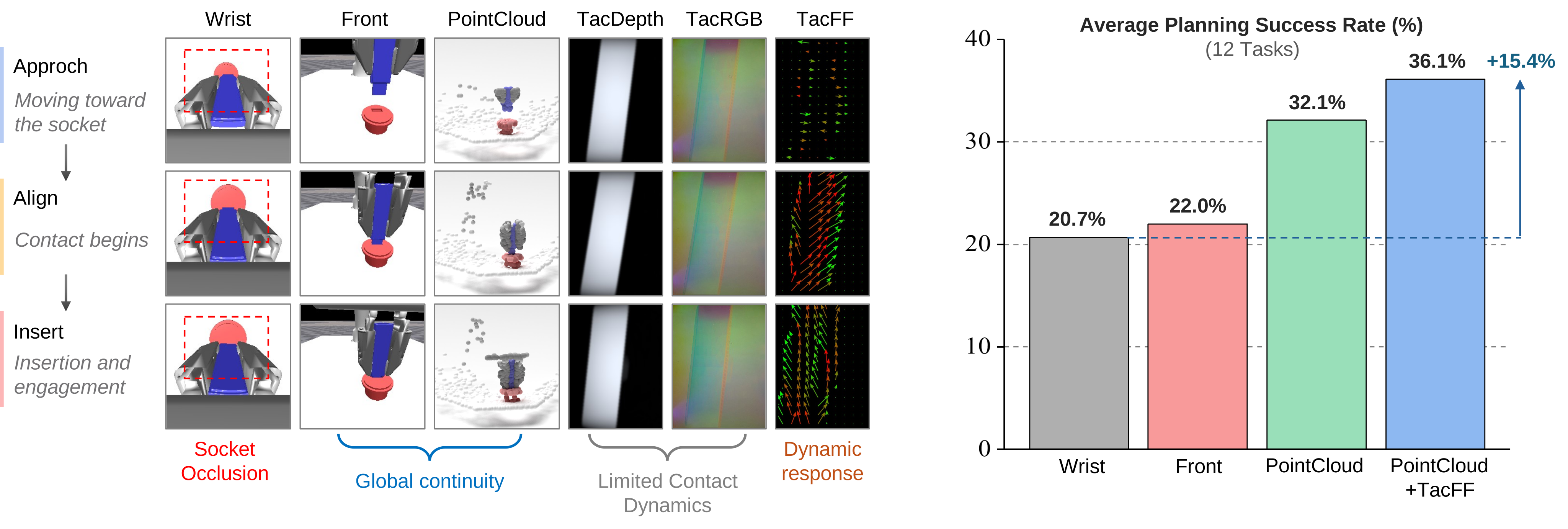
Wrist View and Front View provide RGB visual observations.
Point Cloud captures structured 3D geometry.
TacDepth represents tactile depth deformation,
TacRGB records high-resolution tactile appearance,
and TacFF encodes contact force distributions and directions.
World Model Framework
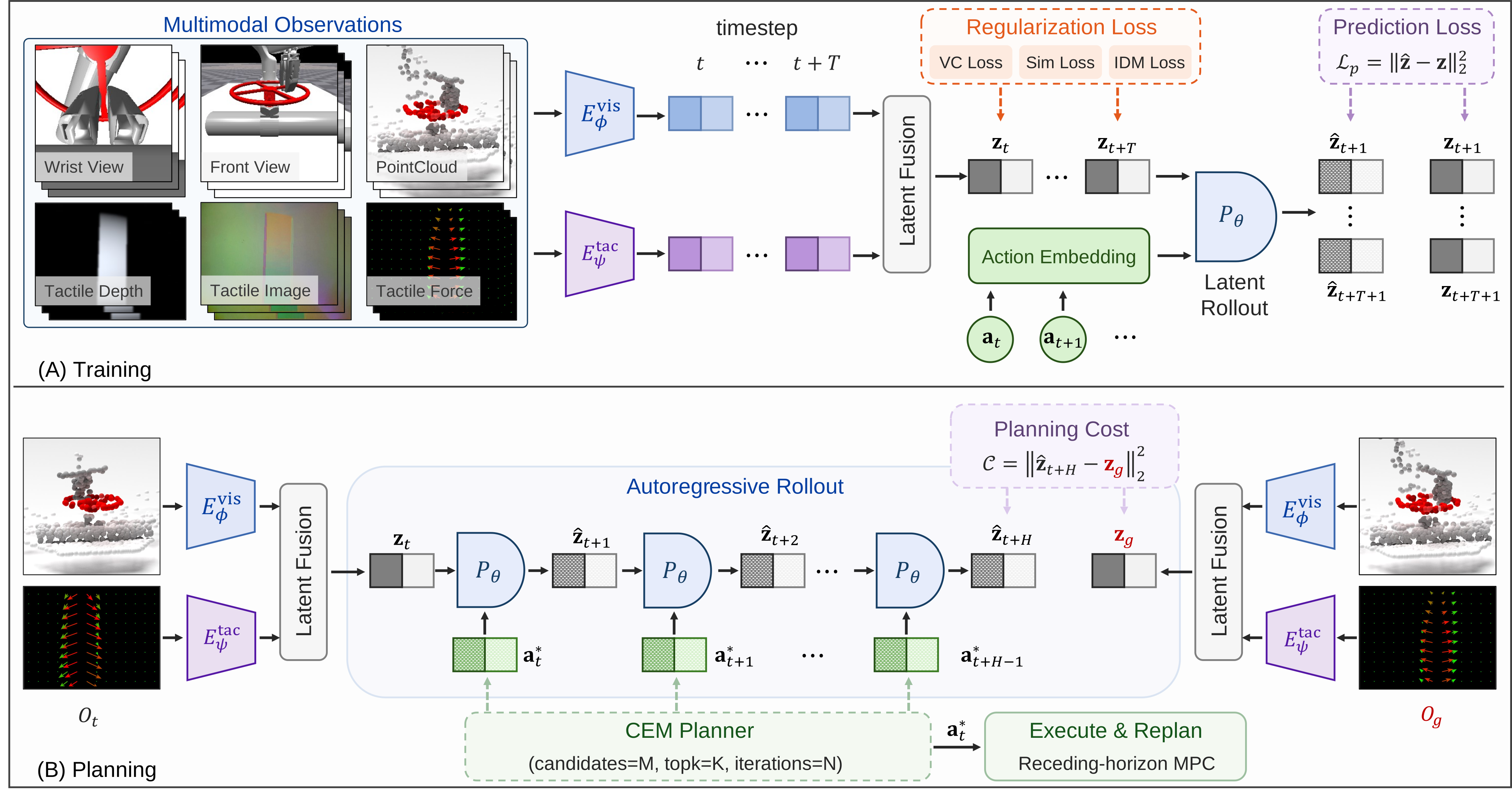
ContactWorld trains latent world models using multimodal visual-tactile observations
and performs goal-conditioned planning through autoregressive latent rollout and model-predictive control.
(A) Training: multimodal latent world model learning.
(B) Planning: goal-conditioned latent rollout with MPC.
What Matters in Vision-Tactile World Models?
ContactWorld reveals three key factors that determine world-model planning performance in contact-rich manipulation.
Representation structure matters.
Representations with stronger spatial structure and temporal continuity consistently achieve better planning performance.
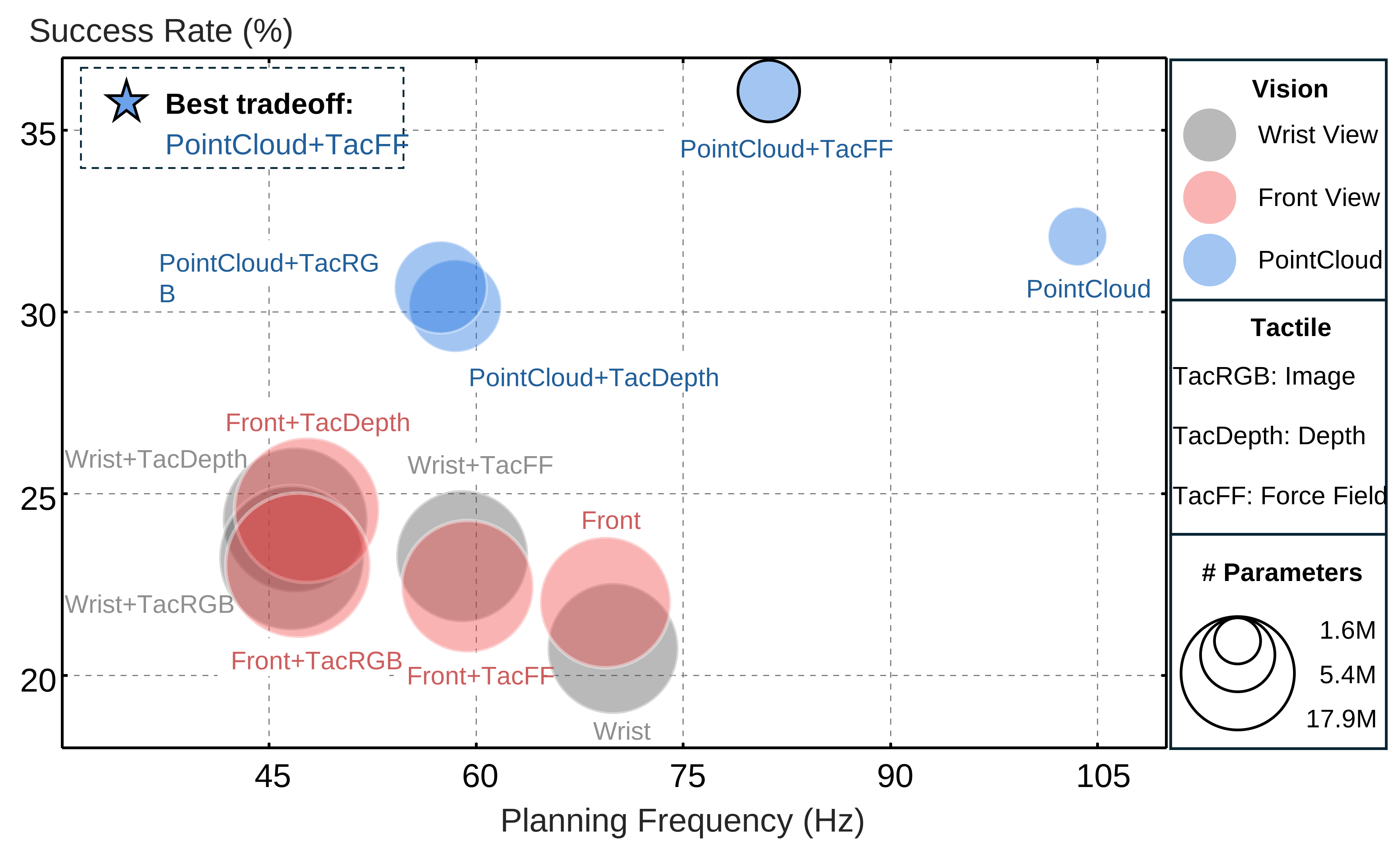
Point clouds outperform image-based observations, while PointCloud+TacFF achieves the strongest overall results.
Cross-modal compatibility matters.
Tactile sensing is not universally beneficial.
The effectiveness of tactile feedback depends strongly on how well it aligns with the visual representation.
PointCloud+TacFF forms the most compatible visual-tactile pair.
Long-horizon robustness matters.
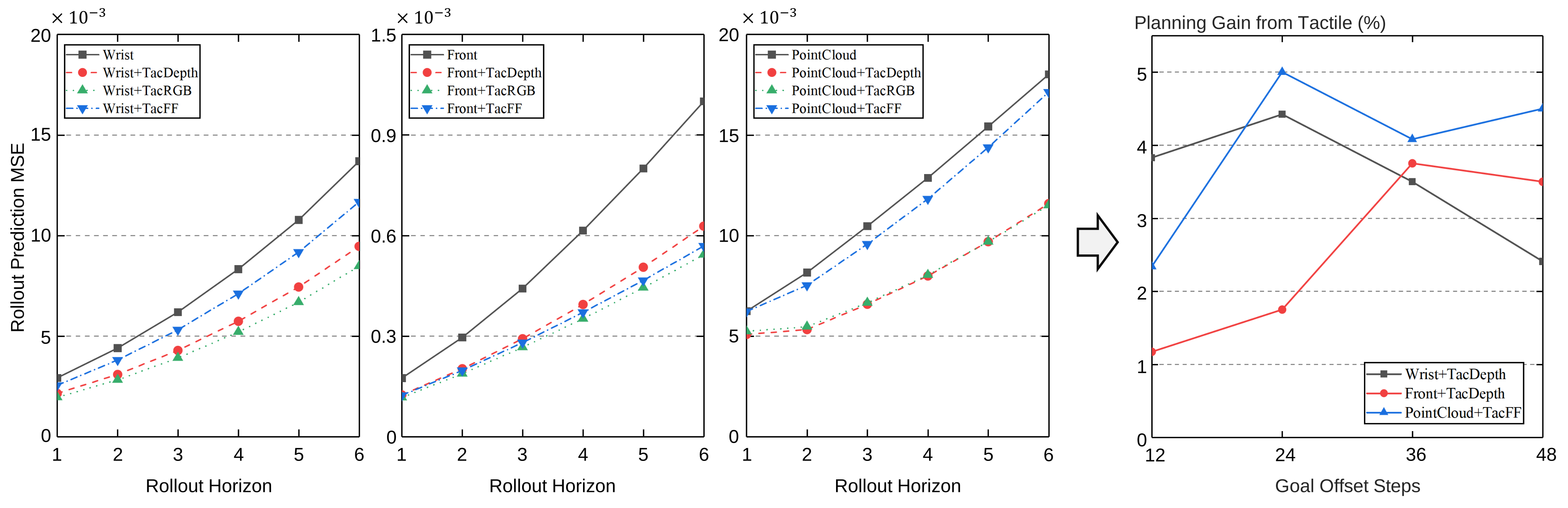
The benefit of tactile sensing grows as planning horizons increase.
Lower rollout prediction error translates into larger planning gains for distant goals.
World Model Planning Gallery
Representative rollouts across all ContactWorld tasks.
Each video compares four world models: Wrist View, Front View, PointCloud, and PointCloud+TacFF.
More modality combinations can be reproduced using the released code.
USB Plug Insertion
Peg Insertion
Power Plug Insertion
Valve Rotation
Bulb Installation
Nut-Bolt Screwing
Loose Lid Removal
Barbed Spike Disassembly
Barbed Flat Disassembly
Blind-Box Exploration
Ball Sorting (Normal Light)
Ball Sorting (Dim Light)
Real-World Deployment
Expanded real-world evaluation with GelSight Mini across four contact-rich manipulation tasks.
Each task compares PointCloud, PointCloud+TacRGB, and PointCloud+TacFF on unseen evaluation trials.
USB Insertion
Elastic Clip Disassembly
Valve Rotation
Ball Sorting
BibTeX
@article{zhang2026contactworld,
  title={ContactWorld: What Matters in Vision-Tactile World Models for Contact-Rich Manipulation},
  author={Zhang, Zhiyuan and Zhou, Pokuang and Zhang, Kaidi and Desai, Adeesh and Amosa, Temitope and Soleymanzadeh, Davood and Lei, Jiuzhou and Zheng, Minghui and She, Yu},
  journal={arXiv preprint arXiv:2606.13877},
  year={2026}
}